Industry
Part of Business development ops: the parts worth your attention
Business development tools worth adopting depend on the data model, not the feature list
Business development tooling turns on the data model, not the feature list: what to test before a system owns your definitions, and what a migration costs.
No product is named here, and that is deliberate rather than coy. The feature comparison you can get anywhere, it changes every quarter, and it is not where these decisions go wrong.
What decides whether a system helps is narrower and duller: what it lets a record mean, what happens to history when that meaning changes, and whether you can get your data back out in a form that is still interpretable.
What to take away
- The moment a system holds your stage definitions, it owns them. Test what happens when a definition changes before you commit, because you will change one within a year.
- Ask what the system does to history. A field that is overwritten rather than versioned quietly destroys your ability to compare periods, and nothing warns you.
- Run the trial on the ugliest real work you have, not on a clean example. Every system handles the clean case.
The four questions that actually decide it
Can it hold a definition, and can that definition change without erasing the past?
Four questions before you buy
- Can a definition change without erasing the past?
- Who can change a field, and is it traced?
- What comes out, and in what shape?
- What does it cost in attention per person?
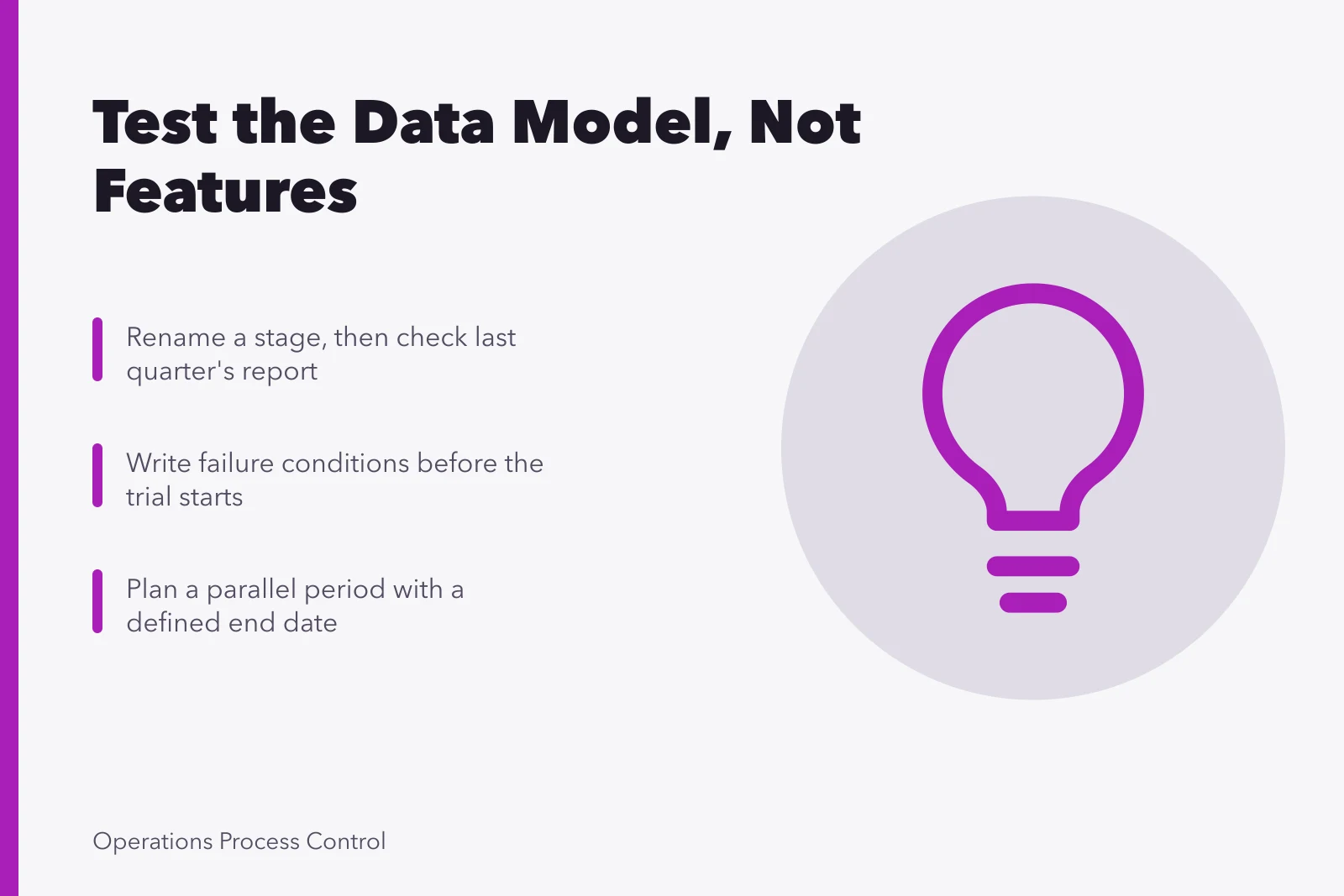
Rename a stage or tighten its entry criteria, then check last quarter's report. If historical records now show the new label as if they always belonged in that stage, your history was rewritten and every before-and-after comparison from then on is meaningless.
Ask to see this happen during an evaluation rather than reading a claim about it.
Who can change a field, and does the change leave a trace?
Picklists get edited by whoever has administrator rights, usually with good intentions, usually on a Tuesday. If the edit leaves no dated record of what the values used to be, you will spend a day next year reconstructing why a report changed shape.
What comes out, and in what shape?
Export something and read it without the system. If the export is a set of identifiers that only mean something inside the product, you do not have your data, you have a copy of it that needs the product to interpret. That is the condition that makes leaving expensive and it is invisible until you try.
What does it cost in attention per person per week?
Not the license. The minutes each person spends entering things they do not need, which is real cost and is never in the business case. Measure it during the trial by asking three people to keep a rough tally for a fortnight.
The three artifacts to have before you look at anything
Written first, these turn a demonstration into a test. Without them, every product looks capable, because a demonstration is designed to.
Three artifacts to prepare first
- Stage definition sheet with buyer-caused events
- Three or four reports written as questions
- Twenty real records, including the messy ones
A stage definition sheet. Each stage, the buyer-caused event that puts a deal into it, and who can move it. If you do not have this, the tool will supply one and you will inherit somebody else's model of how buying works.
A list of the reports you will actually run. Three or four, written as questions. Bring the awkward one, which is usually a comparison across a period during which something changed.
A sample of twenty real records, including the messy ones. The account with two legal entities, the deal that went backward, the one that closed in parts. These are the cases that decide whether the system fits.
Running a trial that tells you something
A trial has to be able to fail. Most are set up so that they cannot: a small group, an enthusiastic sponsor, and a set of tasks chosen because they work.
Four rules for an informative trial
- Give it real work, including messy records
- Set the length in advance and stop on that date
- Write specific failure conditions before it starts
- Have daily users run it, not report writers
Four rules make one informative. Give it real work, including the messy records above. Set the length in advance and stop on that date, or the trial becomes an implementation nobody decided on.
Write the failure conditions before it starts, in specific terms. Have the people who will use it daily run it, not the people who will report from it: those two groups want different things, and only one of them is in the system every day.
The result to look for is not enthusiasm. It is whether people opened it without being asked, to do their own work. A tool that gets opened only when a report is due has already told you what it will be.
What migration actually costs
Three costs, in the order that people underestimate them.
Migration costs in order of underestimation
- Definition reconciliationdecide what old records become
- Parallel periodboth systems half true, with an end date
- Reporting rebuildrewrite reports, reconcile a few deliberately
The definition reconciliation. Your old system and your new one do not carve the world the same way, and someone has to decide what an old record becomes. Every decision is a judgment and the sum of them determines whether your history survives.
The parallel period. For a while both systems are half true. This is unavoidable and it is worth planning as a defined period with an end date, rather than discovering it. Running two versions of a process at once is expensive and sometimes correct, and the tradeoffs are set out in change management.
The reporting rebuild. Every report gets rewritten, and the numbers will not match the old ones. Expect that, and reconcile a small number of them deliberately rather than trying to make everything tie out, which is not achievable and consumes months.
When a spreadsheet is the right answer
Below a certain size a shared sheet with a dozen deals beats any system, and staying there longer than feels professional is often correct. The failure mode is not the sheet. It is the sheet with no agreed definitions, which is the same failure a purchased system has, minus the license.
Have you outgrown the spreadsheet?
Do multiple people overwrite each other?
a system that versions records
Do you need a record's history, not just current state?
The signals that you have outgrown it are specific. More than one person writes to it at once and they overwrite each other.
You need a record's history and the sheet holds only its current state. Or a group with differing work needs one view, and the sheet has become personal variants.
None of those are solved by features; a system that versions records and enforces a shared shape solves them. That is a narrow requirement and a much shorter product list than the category suggests.
The wider question of what a tool can and cannot fix is treated in best management foundations tools 2027. The operating design any of these systems will encode is in business development ops.
The part no product solves
A record system stores what people put in it. If the definitions are contested, the system stores contested data with an authoritative interface, which is worse than a spreadsheet everyone distrusts appropriately.
Agreement on what a field means is human work done before procurement, and it does not get easier after money is spent. Writing a definition two people apply the same way is a specific skill; the method is in operating processes framework.
How definitions behave once they drive reporting, and the distortion that follows, is covered in operating processes metrics.
For a structured view of how an organization shows where its results come from, see the criteria published by the Baldrige Performance Excellence Program. The general effect of a measure becoming a target is described under Goodhart's law.
Common questions
How long should an evaluation take?
Two to four weeks of real use, with the questions above answered on paper first. Longer than that and the evaluation becomes the project.
The decision is being made above us. What is worth sending up?
The stage definition sheet and the three awkward reports. Those two documents change more procurement decisions than any opinion about a product, because they are the things a demonstration cannot answer.
What if the system we are given cannot hold our definitions?
Keep your own field for the evidence layer, recording the last buyer-caused event and its date. It is duplication and it is cheap, and it means your operating decisions are not hostage to somebody else's configuration.
Is it worth migrating history at all?
Migrate what you will actually compare against, usually two years, and archive the rest somewhere readable. Full migrations are expensive and most of the data moved is never queried again.