Costs
Part of Reading change management with a sceptical eye
Change management, one decision at a time
Change management at the switch itself: the freeze, the dress rehearsal, a go or no-go with named criteria, day one cover, and reading the first week honestly.
Planning a change and running one are different jobs. The plan gets attention for months, and the week the change actually happens is improvised by whoever is available.
This page is about that week. It assumes the decision is made, the design is settled, and you now have to move an operation from one way of working to another without losing the work in flight.
What to take away
- Work already in progress at the moment of the switch is the hardest part, and it is what most plans do not mention.
- Rehearse against the real thing. A walkthrough on a slide finds none of the problems a dress rehearsal finds in an hour.
- Decide the go or no-go criteria before the day, in writing, or the decision will be made by whoever is most tired.
- Day one is a staffing problem, not a communication problem.
Work in flight is the whole difficulty
At the moment you switch, some work is half done. It was started under the old arrangement and will finish under the new one, and every one of those items needs a rule.
Three rules for work in flight
Finish under old way
- Speed
- Slow, clean
- Main risk
- Long tail cost
- Best when
- Short tail
- Needs
- Both arrangements
Convert mid-flight
- Speed
- Fast
- Main risk
- Undocumented states
- Best when
- Mapping exists
- Needs
- State mapping
Stop and restart
- Speed
- Immediate
- Main risk
- Customer waiting
- Best when
- Cheapest option
- Needs
- Honest call
Three options, and you generally need more than one.
Finish under the old way. Clean, and it means running both arrangements until the last item clears. Fine when the tail is short and expensive when it is not.
Convert to the new way mid-flight. Fast, and it needs a mapping for every state an item can be in. This is where the surprises live, because the old arrangement almost always has states nobody documented.
Stop and restart. Honest, occasionally the cheapest, and unacceptable where a customer is waiting.
Do this before anything else: list every state work can be in right now, and write the rule for each. The list will be longer than you expect. Where the states are not written down anywhere, that is itself the finding, and the technique for recovering them is in operating processes framework.
The freeze, and what it costs
Most changes need a period where nothing new is added and nothing else is altered. Two reasons: you want a stable target to test against, and you want to be able to attribute anything that breaks.
The freeze and its surge
- Freeze startnothing new added, nothing altered
- Freeze endstable target tested, breaks attributable
- After freezebacklog arrives all at once
- First daysbacklog plus change together
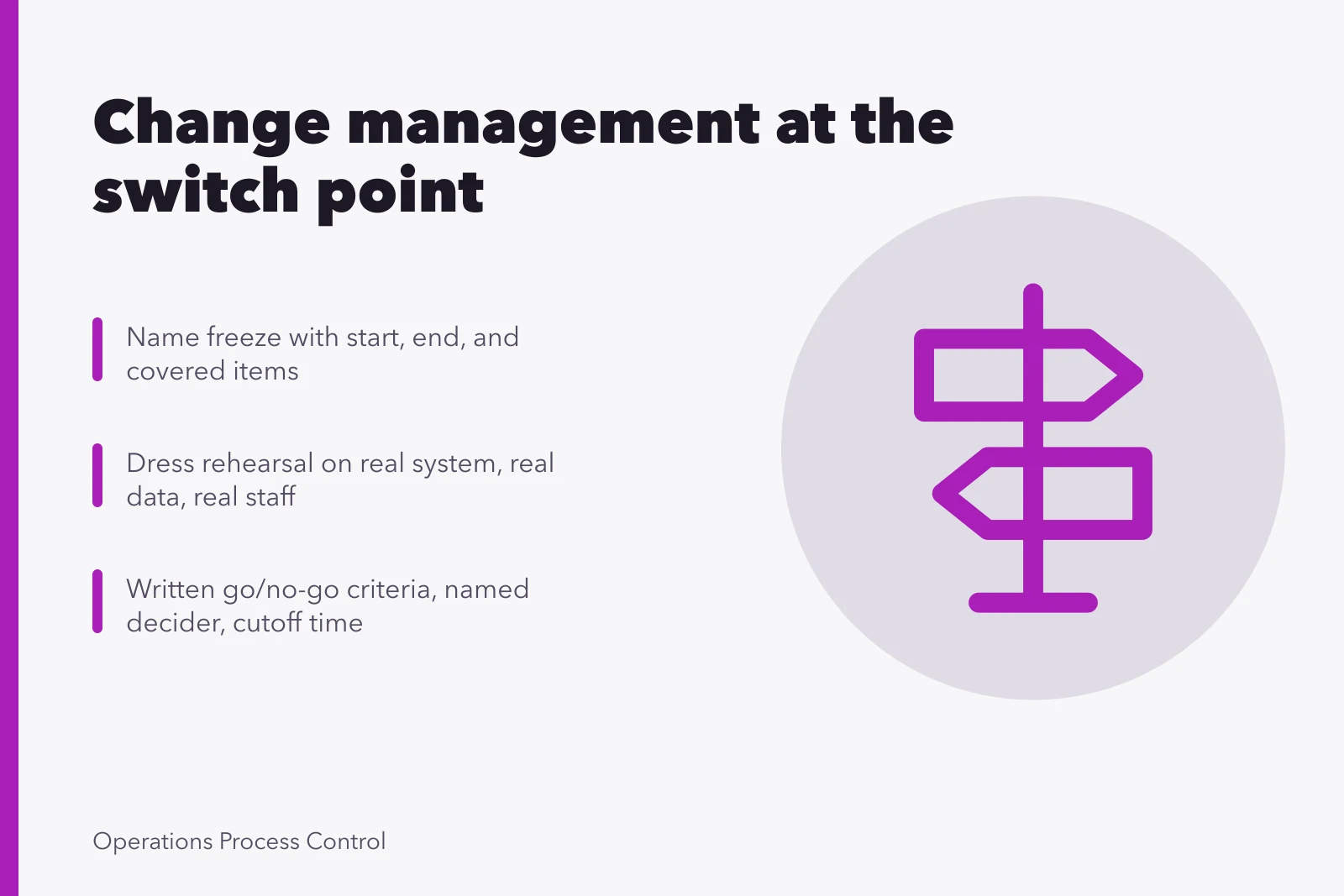
Name the freeze explicitly, with a start, an end, and a list of what it covers. An implied freeze gets broken by someone who did not know it existed.
The cost is real and worth stating out loud. Work queues up during the freeze, then arrives all at once afterward. So the first days on the new arrangement carry the backlog and the change. Plan for that surge, or you will read the slowness as evidence the change failed.
Where the surge is unacceptable, a shorter freeze with a narrower scope is better than a long one that people quietly ignore.
Rehearse it, in the real environment, with the real people
A dress rehearsal is the highest value hour in a change and the one most often skipped for lack of time.
What makes it worth doing:
What makes a rehearsal real
- Use actual system, forms, data shapes
- Workers do it, not designers
- Run the abnormal path and rollback
- Time the cutover
- Write down every question asked
If a rehearsal is impossible, say so as a risk rather than treating the absence as neutral. And where the change is genuinely irreversible, the rehearsal moves from useful to necessary, because there is no second attempt.
Go or no-go, decided in advance
On the day, someone has to say whether to proceed. Under time pressure and with an audience, that decision goes the way of whoever is most confident unless the criteria were written down beforehand.
Go or no-go criteria
Are the written conditions all true?
proceed as planned
automatically no after latest time
A usable set has three parts. The conditions that must be true to proceed, stated so that they can be checked rather than argued. The person who decides, named. And the latest time the decision can be made, after which the answer is automatically no.
Two habits protect it: ask for written criteria a week ahead, when nobody is invested in the day. Give anyone in the room a way to raise a blocking concern without arguing with the most senior person present.
The concerns that matter are usually held by someone junior who noticed something during the rehearsal. The general question of who is allowed to stop work is treated in management foundations.
Day one is a staffing decision
The most common day one failure is not a technical one. It is that the people who understand the change are in a meeting about the change while everyone else is trying to do the work.
What helps, in rough order of value:
Day one staffing moves
- Experienced people present, not on standby
- Reduce volume deliberately first day or two
- One place for questions, answered publicly
- Log every question and workaround
- Decide rollback trigger and caller in advance
Expect the first days to be slower than both the old way and the eventual new way. Saying that in advance is the difference between a predicted dip and a crisis.
Reading the first two weeks without fooling yourself
Early numbers after a change are noisy, and everybody has a position they want them to support.
Three cautions. Volume is distorted by the freeze backlog, so throughput comparisons in the first week mean very little. People are learning, so speed will improve regardless of whether the change was a good idea. And the loudest feedback comes from whoever the change costs the most, which is information rather than a verdict.
Read early, not the numbers
- Questions people asked
- Workarounds they invented
- Anything done outside the new arrangement
To separate a real signal from ordinary noise, once you have enough points, use the counting discipline in operating processes metrics. The questions worth asking the people doing the work are in operating processes questions.
Closing it out
A change is finished when the old arrangement is switched off, not when the new one is live. The gap between those two is where most of the wasted cost sits: two ways of working, both supported, neither fully trusted.
Closing out the change
- Go-live datenew arrangement live
- Same timeset date to switch off old path
- First fortnightwrite the short account
- After switch-offchange is finished
Set a date for switching off the old path at the same time you set the go-live date. Where you cannot, name what has to be true before you can, and give it an owner.
And write the short account of what happened while people still remember it, because the record you do not make in the first fortnight will not be made at all. What that record should contain, and why it cannot be reconstructed later, follows from the wider argument in change management.
Two external references are worth having on hand for the human side of this. The Health and Safety Executive's material on organizational change is written for safety critical settings. It makes the general point that changes to staffing and workload need assessing before they are made rather than after.
The pattern by which a temporary workaround becomes the permanent way of working, and stops being visible as a deviation, is described as normalization of deviance, which is what the day one workaround log exists to prevent.
Common questions
How long should we run the old and new arrangements together?
As briefly as the risk allows, with a date set in advance. Parallel running is expensive and it is also the thing that keeps getting extended, because extending it is always the lower risk decision in the moment. Naming the end date up front is what stops the drift.
What if we discover a serious problem on day one?
Use the criteria you wrote for the rollback, and if you did not write any, decide quickly whether the problem is recoverable within the day. The worst outcome is a long argument while the work piles up. A reversal that is decided in an hour costs much less than one decided in a week.
Should we tell customers?
Where the change is visible to them, yes, before rather than after, and in terms of what they will experience rather than what you are doing internally. Where it is genuinely invisible to them, saying nothing is honest. The test is whether they would feel misled on discovering it.
Nobody has time for a rehearsal. What is the minimum?
One person doing one real item end to end on the new arrangement, timed, with someone watching. That is an hour and it will find something. A rehearsal skipped entirely is a decision to find those problems on the day with an audience.