Reviews
Part of Business development ops: the parts worth your attention
The business development ops checklist that catches what audits miss
Business development records fail nine admissibility tests before they belong in a forecast: the failing value for each field, and how to run the check weekly.
What to take away
- Nine fields decide whether a record belongs in a forecast, and each fails on one specific value: a stage moved by a seller action, a close date on the last day of a quarter, a next step that cannot go into a calendar.
- Read the record, not the salesperson. A field that cannot be defended is a fact about the data.
- Run the check weekly on a random dozen records, inside the pipeline conversation you already hold, and fix the failing field during the call.
- A failed record leaves the forecast and stays in the pipeline, with no penalty. When failing costs someone their number, nothing on the record is true.
The nine fields and the value that fails each
A record is admissible when someone who missed the meeting can read it and say what happens next, who does it, and what would have to be true for the deal to close. Most records fail that bar.
The record is the last link in a chain that starts with who you choose to pursue, covered in business development ops.
Read each record field by field. When you hit a failing value, stop and fix that field before moving on, because every field downstream inherits the error.
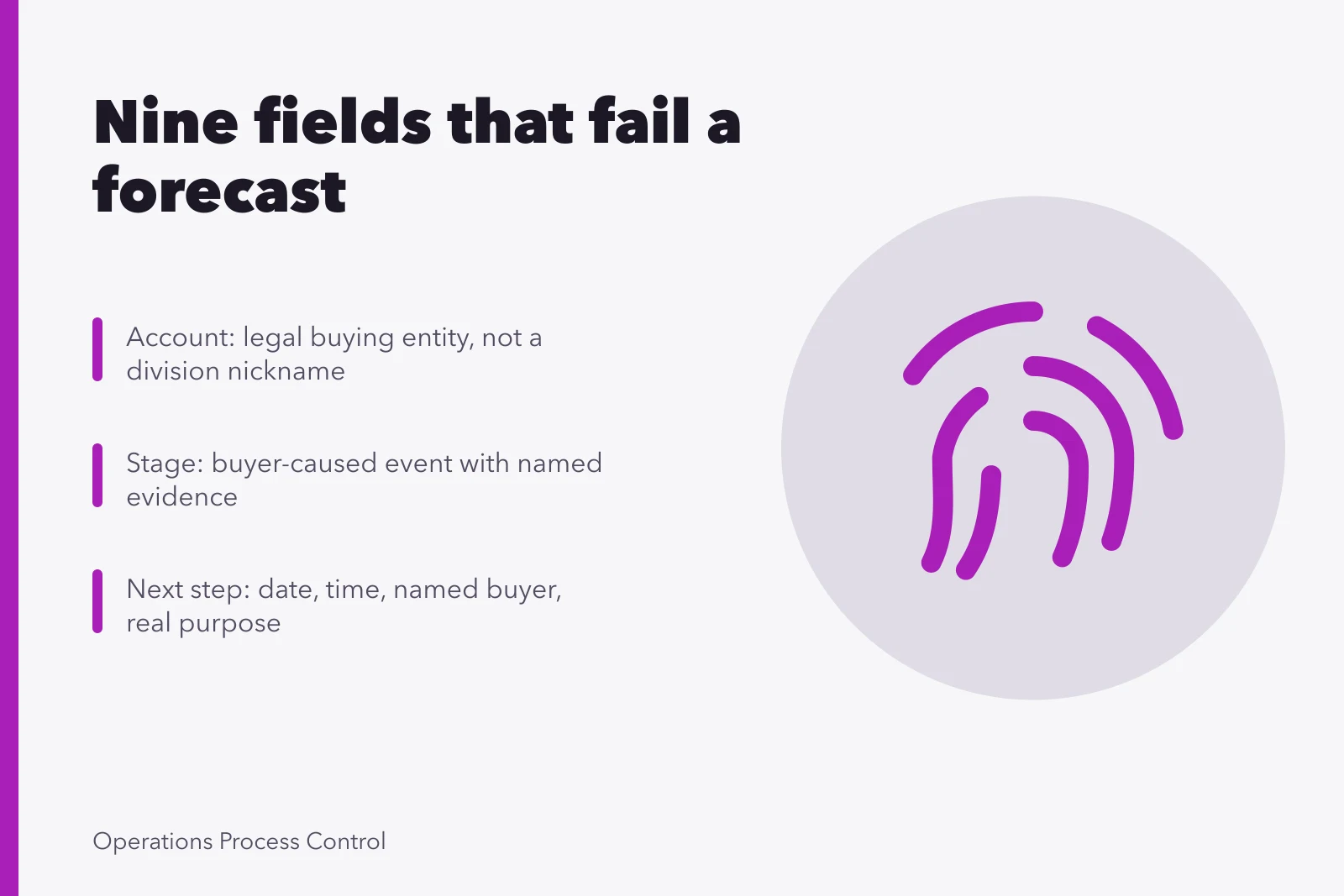
The nine fields
- Buyer-side contact
- No named person who can sign or fund
- Stage
- Last movement was a seller action
- Next step
- Cannot go into a calendar now
- Close date
- The last business day of a quarter
- Competing option
- Blank, or none, with no alternative named
- Approval path
- No dated security, legal or procurement step
- Budget
- No funding source and no owner
- Evidence
- Last milestone backed only by an internal note
- Last buyer contact
- No dated buyer-side touch since the last stage change
Nine fields, and the value that fails
- Accounta name only one person recognizes
- Stagemoved after an internal meeting
- Close datethe last week of your quarter
- Amounta round number with no scope behind it
- Next stepan intention, such as follow up
- Buying processblank, or the same as every record
- Decision ownera contact who likes you
- Competing optionnothing recorded
The stage field fails most often. A stage should describe something the buyer did, and most pipelines let it describe something the seller did. The competing option field fails almost as often, because buyers often do nothing at all.
Once a field decides who gets credit, it starts describing what earns credit. That is what Goodhart's law names. The general case, a countable number bending behavior, sits in operating processes metrics.
The next step field fails today
An admissible next step has a date, a time, a named person on the buyer's side, and a purpose that is not a check-in. Test it by asking whether it could go into a calendar right now without another message. If it could not, it is a hope with a verb.
Is this a next step?
Can you calendar it now without another message?
It is a next step: date, time, buyer, purpose
It is a hope with a verb
A close date can be wrong for three months before anyone notices. A missing next step is wrong today.
This is the only field that fails immediately. The other eight describe a record that may be stale. This one says whether the deal is moving at all.
Running the check weekly
Five steps, once a week, inside a review you already hold:
- Pull a dozen records at random. Do not pick the ones you already distrust.
- Open the record with the owner, and read it out loud.
- Work the fields in order, and stop at the first failing value.
- Fix that field before the call ends. A note saying the field was wrong changes nothing.
- Write down the pattern across the sample, not whose records failed.
A dozen records read properly tells you more than four hundred skimmed.
Four habits that keep the check honest
Sample, do not sweep. A random dozen read carefully beats an audit of everything, and it is small enough that you will run it.
Read with the person, not about them. The check runs out loud with the record open. An audit sent afterward reads as an accusation and invites defensive edits.
Fix the field during the call. If a next step is not schedulable, the output is a scheduled event made while you are both there.
Let a record fail without a penalty. A deal that fails comes out of the forecast and stays in the pipeline. If failing costs someone their number, nothing is true. Keeping the count apart from the consequence is the argument about people in management foundations.
What the check cannot see
It tests the record, so it is blind to everything not written down. A deal can pass all nine fields and still be a fantasy, because a well-documented fantasy is still a fantasy.
It also asks nothing about whether the account deserves coverage. Fit and sequencing are separate questions from whether a record is readable, and they need their own meeting with their own evidence.
Nor does it measure how long a deal has sat in one stage. A record can be complete and untouched for a quarter. Effort leaves its trace in the calendar rather than in the record.
A record can also be admissible and still be wrong. The buyer may have changed priorities last week, and no field will show it, because fields hold what someone typed.
And it cannot tell you whether your stage definitions are any good. If your stages describe your internal process instead of the buyer's, every record passes against a bad standard. How to read the shape of a real process is in operating processes framework.
The same habit outside sales
Public bodies that report operational performance publish the definitions alongside the figures. The Baldrige Performance Excellence Program at NIST builds its criteria around whether an organization can show where its results come from.
Regulated recordkeeping runs on the same logic. Records in scope of the FDA data integrity guidance have to show who changed what, and when.