Features
Part of Reading change management with a sceptical eye
Change management tools: four documents beat any tracker
Change management needs four documents more than it needs a product: what each contains, why a tracker turns into a graveyard, and when a plain file wins.
Change management tools are usually the first question asked and the last thing that decides anything. ServiceNow Change Management, Jira Service Management, Freshservice, ChangeGear and Confluence all store a record and move it through approvals.
The tooling question gets asked too early, in place of a question about what is written down and who reads it. A change needs four documents. Most of what a tool sells is a place to store them and a workflow around them. The storage was never the problem.
What to take away
- Write the four documents first, in whatever you already have. Google Docs, a Microsoft Lists table or a Confluence page will hold them.
- If the documents are not being written, no tool creates them. If they are, a tool mostly changes who can see them.
- A change tracker becomes a graveyard the moment updating it is somebody's job rather than somebody's need. Watch for the change that has been at ninety percent for two months.
- The test for any of this is whether the person doing the work on the day opens it. Everything else measures reporting.
- Jira Service Management is free for up to 3 agents and about $22 per agent per month after that. Confluence is free for up to 10 users.
The four documents
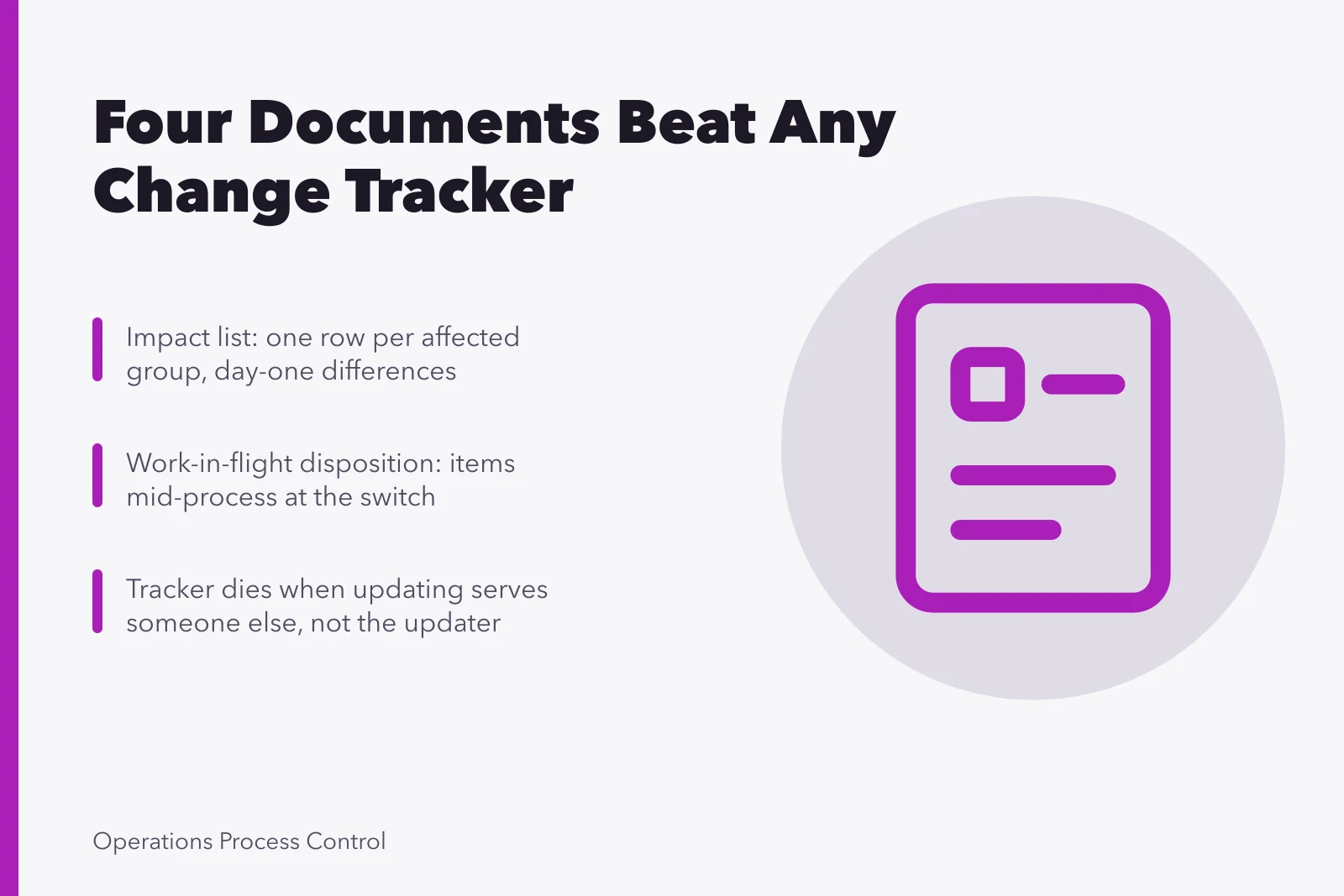
The impact list. One row per group affected, saying what is different for them on day one and who they ask when it does not work. This is the document that most often does not exist, and it is the one that prevents the most damage.
It is short: a table, rarely more than a page. Microsoft Lists holds it and comes with Microsoft 365 Business Basic at $6 per user per month. A Google Sheet does the same job for free.
The four change documents
- Impact listone row per affected group
- Work-in-flight dispositionitems mid-process at switch
- Rollback definitiontrigger, decider, deadline
- Dated logfive minutes a day during change
The work-in-flight disposition. What happens to items part way through the old process at the moment of the switch, including items held by people who are away. Every rollout that loses something loses it here. Notion, free for personal use, or a Confluence page keeps the list where both teams can see it.
The rollback definition. Not a plan to revert, which may not be possible, but a written statement of what would trigger a decision, who makes it, and by when it stops being available. A reversal that is only theoretically possible on day fourteen is not a rollback.
The dated log. Kept during the change by someone doing the work. Five minutes a day. It is the only one of the four that is written after the change starts, and it is the only one that will still be read a year later. A plain document with dated entries beats a status field.
Three of these fit on a page each. That is not a simplification for this article. Keeping them to a page is what makes them get written and reread.
Why a tracker becomes a graveyard
The failure is predictable and it has one cause: the record is updated for someone else's benefit rather than the updater's.
How a tracker becomes a graveyard
- Record updated for someone else's benefit
- Statuses change only before reviews
- Percentages appear then stop moving
- Abandoned changes stay open at ninety percent
- Rows never close, register stops informing
The register itself is a commodity. ServiceNow Change Management, Jira Service Management, Freshservice and ChangeGear all ship one, with approval gates and a change calendar. All four decay the same way.
Two things prevent it, neither of them a feature. Make the record something the person running the change needs to look at. That usually means it holds the impact list and the open questions rather than a status field.
Close changes explicitly, with a date and an outcome, including the ones that were dropped.
A register whose rows never close stops carrying information within two quarters. That is the same slow decay that turns any unclosed exception into permanent practice, described as normalization of deviance.
What a tool genuinely helps with
Three things, and they only matter above a certain scale.
When a tool earns its keep
Shared document
- Collisions across teams
- Hard to see
- Versioned history
- Overwritten
- Date reminders
- Pass silently
- Scale needed
- A handful
Bought tool
- Collisions across teams
- Shared sorted view
- Versioned history
- Pre-switch readable
- Date reminders
- Triggers reviews
- Scale needed
- Many concurrent
Seeing collisions across teams. When several changes land on the same group in a quarter, a shared view sorted by affected team pays off. ServiceNow Change Management does this with a change calendar and conflict detection on configuration items. Jira Service Management links every change to the request queue it touches.
Assembling that by hand across a dozen sponsors is tedious enough that people stop. Build one row per change, sorted by the team carrying it, not the sponsor paying for it.
Keeping history. A record of what a change said it would do, versioned, so that the version from before the switch is still readable afterward. Documents in a shared folder get overwritten, and the pre-switch version is exactly the one you want in week six.
Confluence, free for up to 10 users, keeps page versions. Standard runs about $6 per user per month.
Reminding people of dates that they did not set. Trigger reviews, end-of-parallel-period dates, and closure dates are all things that pass silently otherwise. Smartsheet, from about $9 per user per month, and monday.com, from about $9 per seat, both send reminders from a date column.
None of these are worth a procurement until they are actually hurting. Below about a handful of concurrent changes, a shared document does all three adequately.
The other category is change-specific rather than IT-service change. Prosci sells the ADKAR model and an eToolkit for practitioners. WalkMe and Whatfix overlay guidance on the live application for the people learning the new process.
Choosing without regret
If you are going to buy something, four questions decide it, and none of them are about features.
Four questions before buying
Can the four documents live in it readably?
keep documents, not dropdowns
tool destroys the document
Can the four documents live in it in a form people will read, or does it convert them into fields? A tool that turns the impact list into a set of dropdowns has destroyed the document while appearing to store it.
Who can see it? A change record visible only to sponsors will be written for sponsors. Visible to the affected teams, it gets written differently and read by the people who can correct it.
Does closing a change require more effort than leaving it open? If yes, you will accumulate open changes forever, and the register will stop being usable regardless of what else it does.
What does it cost per person per week in attention? Ask three people to keep a rough tally during any trial. The license is knowable and this is not, which is why only one of them appears in a business case.
These are list prices as of 2026, before any volume discount. Jira Service Management is free for up to 3 agents, then about $22 per agent per month on the Standard plan. Confluence is free for up to 10 users, and around $6 per user per month after that.
Freshservice starts near $19 per agent per month. Smartsheet runs about $9 to $32 per user per month depending on plan, and monday.com about $9 to $19 per seat. Microsoft Lists comes with Microsoft 365 Business Basic at $6 per user per month, and Google Docs and Sheets are free with a Google account.
ServiceNow Change Management and ChangeGear publish no list price, and both are quoted annually per agent. Prosci certification typically costs several thousand dollars per seat. WalkMe and Whatfix usually land in annual contracts worth tens of thousands of dollars.
The wider version of this reasoning, applied to tools in general rather than to change work, is in best management foundations tools 2027. The data-model questions that decide whether a system can hold your definitions are in best business development ops tools 2027.
When a shared file is the right answer
For most teams, most of the time. Four short documents in a shared folder, with dates in the filenames, does the whole job for a change affecting one or two groups. Google Docs and Sheets cost nothing with a Google account, and Microsoft Lists is already on most Microsoft 365 seats.
Signals you outgrew the shared file
- Several changes hit one team, total invisible
- Documents overwritten, pre-switch version gone
- Same questions asked with no place to look
Notice that none of those signals are about the change itself being complicated. Complexity in a single change is handled by writing more carefully, not by better software. What to write and in what order is in change management. The conditions to confirm at each phase are in change management checklist.
The method for making sure the plan targets the process as actually operated is in change management framework. Guidance on organizational change from the UK Health and Safety Executive treats the written assessment, rather than the tracking of it, as the substance of the work.
Common questions
We already have a tracker nobody updates. Replace it?
Not yet. Find out whether anyone needs what is in it. A tracker nobody updates and nobody reads should be closed rather than migrated. A tracker nobody updates but several people read has a different problem, which is that the writers get nothing from writing.
Can the four documents just be sections of one file?
Yes, and for a small change that is better. They are separated here because they are written at different times by different people, not because they need different files.
What about the change nobody wrote down because it was too small?
Small changes still need the day-one sentence and the work-in-flight answer. Everything else can go. If those two are missing, the change is not too small to plan, it is too small to have been noticed failing.
How long should the four documents be kept?
Until the next change to the same process, which is when someone will want to know what the last one said it would do. In practice a year is enough for the first three, and the dated log is worth keeping longer because it is the only record of what actually happened.
Which change management tool should a small team buy first?
None. Jira Service Management covers up to 3 agents on its free tier and Confluence covers 10 users, and that is enough for a change affecting one or two groups. Buy only when collisions, overwritten versions or missed dates are already costing you.
Is ServiceNow worth it for one change?
Rarely. ServiceNow Change Management is sold with the wider ITSM suite on annual per-agent contracts and no public list price. It pays off when dozens of changes hit the same services each quarter and you need conflict detection across them.