Maintenance
Part of Reading change management with a sceptical eye
What to expect from change management framework, 2027 edition
Change management fails when the plan targets the drawn process instead of the operated one: four kinds of divergence, and how to find the real process in a week.
A change is designed against a description of how the work is done. The description is almost never accurate. The gap between it and the operated process is where changes go to die.
This is not a complaint about documentation. Every operated process drifts away from its written form, for reasons that are usually sensible at each step. The point is that a plan built on the written form will hit the real one, and the real one will win.
The 2027 edition of a change management framework is not one boxed product. As of 2026, the named editions most American operations inherit are Prosci ADKAR, Kotter's 8-Step Process, Bridges Transition Model, ACMP's Standard for Change Management, and McKinsey 7-S.
Expect their 2027 refreshes to add process-mining evidence and hybrid-work checks. No publisher has announced a 2027 date. Prosci revises its certification and materials on its own cycle, ACMP revises the Standard through its standards process, and the book-based models change only when a new edition appears. Treat 2027 as a planning label, not a launch date.
What to take away
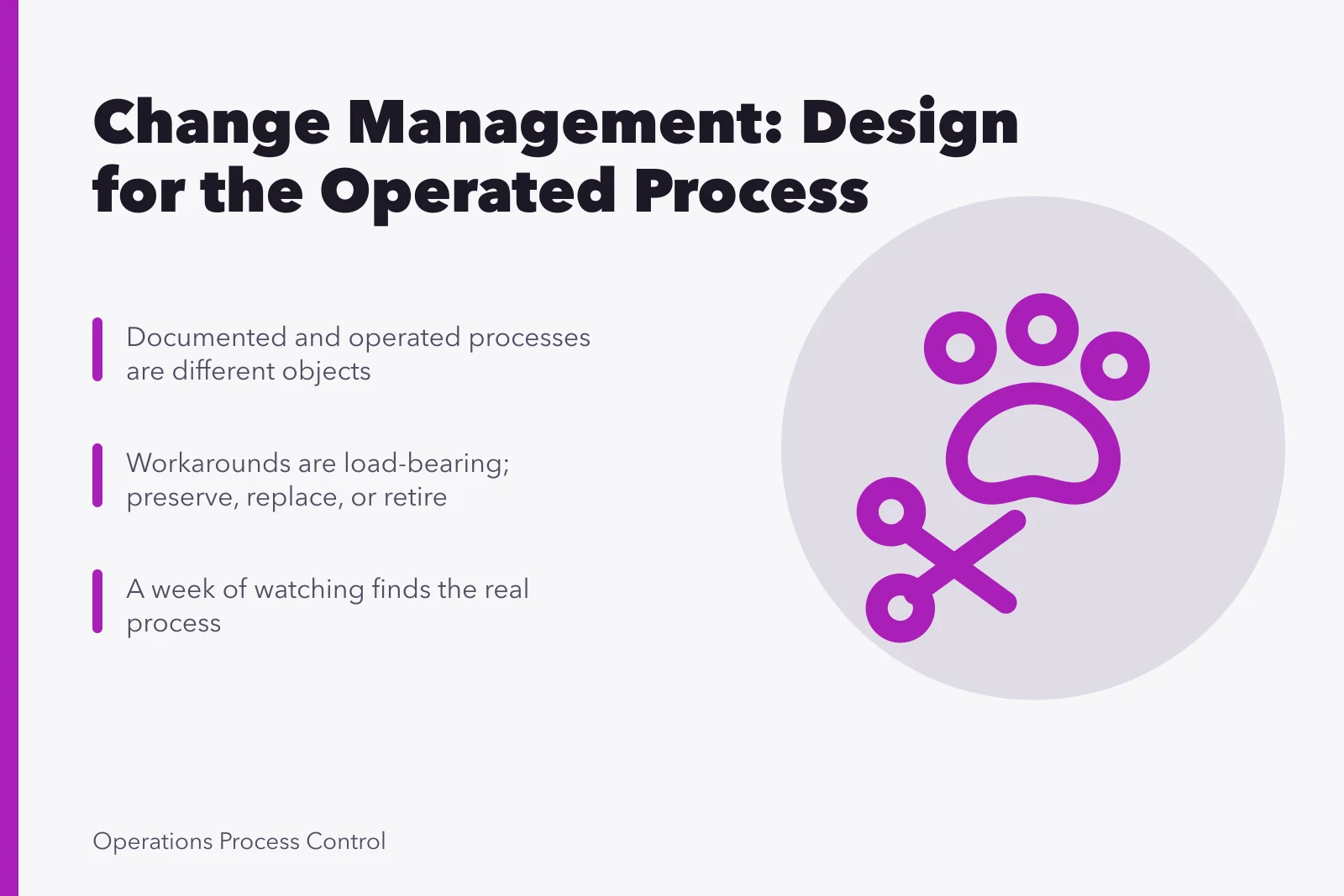
- Design against the operated process, not the document. Find out what it is before you plan.
- Workarounds are load-bearing. Each holds up a case the written process does not handle. Removing one without replacing its function breaks things nobody predicted.
- A week is enough. Watch the work, trace cases backward, ask about the last case. You do not need a mapping project, a consultancy, or a system.
- Named 2027 inputsProsci ADKAR, Kotter's 8-Step Process, Bridges Transition Model, ACMP's Standard, and McKinsey 7-S. They frame people and organization. They do not replace watching the work.
What the 2027 editions say, and why the two versions come apart
The named frameworks differ in use and cost. Prosci ADKAR tracks five individual outcomes: awareness, desire, knowledge, ability, and reinforcement. Prosci certification typically costs $4,000 to $4,500 and runs three days. It suits change leads who need adoption measures.
Kotter's 8-Step Process runs from urgency and a coalition to short-term wins and cultural anchoring. It suits executives driving a top-down change. The book Leading Change typically lists for $25 to $35.
Bridges Transition Model covers endings, the neutral zone, and new beginnings. It suits reorganizations and layoffs where the people-side loss is the hard part. Managing Transitions typically lists for $18 to $25.
ACMP's Standard for Change Management defines the discipline and backs the CCMP credential. CCMP eligibility requires 21 hours of change management training and three years of experience. McKinsey 7-S maps strategy, structure, systems, and shared values. It also covers skills, style, and staff, and it suits diagnosis rather than step-by-step delivery.
No named framework removes the divergence problem. Four forces pull the two versions apart, and none of them involve anyone doing anything wrong.
Volume changes. A step designed for a handful of cases a day becomes impossible at forty. People compress it. The compression is never written down because it was a survival measure, not a decision.
Exceptions accumulate. Someone hits a case the process does not cover, invents a handling, and it works. The next person copies it. Within a year it is standard practice with no author and no record.
Systems change underneath. A field is renamed, a screen is reordered, a report moves. The process document was accurate the day it was written. Nobody rereads it when the tool changes.
Risk tolerance moves. A check gets skipped once under time pressure and nothing bad happens. It gets skipped again. The gradual acceptance of a departure from the standard, because the last departure had no consequence, is named normalization of deviance.
Four kinds of divergence, and what each means for your Prosci, Kotter, or Bridges plan
The undocumented step. Something people always do that appears nowhere, often a check, a heads-up message, or a reconciliation. Remove the conditions for it and whatever it was catching gets through. The first evidence is a customer complaint two months later.
Four kinds of divergence
Divergence
- Undocumented step
- Always done, never written
- Documented step nobody does
- Written but skipped
- Branch is main path
- Exception is most volume
- Person-shaped step
- Works via one person
What it looks like
- Undocumented step
- Removal lets defects through
- Documented step nobody does
- Deleting may break real work
- Branch is main path
- Change targets minority case
- Person-shaped step
- Reroute loses knowledge silently
Risk to your plan
- Undocumented step
- Documented step nobody does
- Branch is main path
- Person-shaped step
The documented step nobody does. The reverse case, and the more common one. Find out why before deleting it. Sometimes it is dead. Sometimes it is impossible as written, so people do it differently elsewhere.
The branch that is really the main path. The document describes a standard case and an exception. In practice the exception is most of the volume. Planning around the standard case means planning around a minority of the work.
The person-shaped step. A step that works because one specific person knows something. It looks like a process step on paper and it is not one. Reroute work around that person and the knowledge goes with it. This one produces the worst surprises.
Finding the real process in a week
Three methods, in ascending order of effort. You usually need all three because each is blind to different things.
Finding the real process
- Watch the work happen for a full cycle
- Trace five completed cases backward
- Ask about the last case, not usual
- Timebox the whole effort to one week
- Write divergences, not a new document
Watch the work happen. Sit beside someone doing it, for a full cycle, saying nothing. Look for the moments they open something not in the document, message someone, or hesitate. The practice of going to where the work is done rather than reading about it is called gemba. It is uncomfortable for both parties for about twenty minutes, then it stops being.
Trace individual cases backward. Take five completed items and reconstruct what happened to each. Use timestamps, messages, and whatever record exists. This catches the cases nobody remembers, including the ones that got stuck and were rescued informally.
Ask about the last one, not the usual one. People describe the process they believe in when asked in general. They describe the process they ran when asked about a specific recent case. The interview technique for this is set out in operating processes questions.
Two rules keep this from turning into a project. Timebox it to a week and accept that you will not have everything. Write what you find as a list of divergences from the document, not as a new document. Producing a new document is how this turns into six weeks of formatting.
Designing the change against what you found
For each divergence, decide one of three things and record which.
Decide each divergence
Is the job the workaround does still real?
Preserve it, keep the job done
Is the current handling bad?
Preserve it. The workaround is doing a real job. Your change must keep that job done, whether by the same means or another. This is the answer more often than people expect.
Replace it. The job is real, the current handling is bad, and the change provides something better. Say explicitly what replaces what. When the old handling disappears, somebody notices whether the replacement is working.
Retire it. The job no longer exists. This needs evidence, not an assumption. The evidence is usually a count of how often it catches something.
Worked example. An operator emails the account manager before releasing an order. The document does not mention it. The email exists because the credit check lags a day.
Preserve it if the new system still cannot check credit in time. Replace it when the system checks credit in real time. Retire it only if slow payers are gone from the book, and only with a count to prove it.
Handled this way, the plan is no longer a target state description. It becomes a list of specific changes, each with a named consequence.
That document is much smaller and more testable. It is the one that survives contact with the operation.
The general anatomy of a process, and which parts of it are load-bearing, is set out in operating processes framework.
What this framework does not cover
It says nothing about whether the change is a good idea. A perfectly designed change to the wrong thing is still wrong. The question of what the change is meant to achieve sits before this.
It also says nothing about people, which is the other half of the work: who loses something, who finds out when, and what the announcement says. That half is in change management. The mechanics of the week the switch happens are in change management guide.
And it does not survive being done once. The operated process starts diverging from your new document the day it goes live. The honest version of this framework is a habit rather than a phase. What to do with the numbers afterward, so you can tell whether the change did anything, is in operating processes metrics.
The habit outlasts the framework. After the change goes live, go back and watch the work again.
Common questions
Which 2027 edition should we plan against?
Match the model to the job. Prosci ADKAR gives adoption measures, Kotter gives top-down execution, Bridges gives reorganizations, ACMP's Standard gives a common discipline and the CCMP credential, and McKinsey 7-S gives diagnosis. Costs, durations, and book prices are in the section above.
Is this not just process mapping?
Mapping usually produces a diagram of the intended process, drawn in a room. The diagram is the deliverable. This produces a list of differences between the document and the work. The list is the deliverable. The second is smaller and more useful for planning a change.
What if people hide the workarounds?
Some will, especially where a workaround breaks a stated rule. Be explicit that you are looking for what makes the work possible, not for who is out of compliance. Then behave that way when you find something. You get one chance at this.
We have no time for a week of observation.
Then trace three completed cases from records. That takes an afternoon and catches the largest divergences. It is worse than watching. It is far better than planning from the document.
Who should do the finding?
Someone who will still be there after the change, and preferably not the person who wrote the original process. Authors read their own documents into what they see. That is not dishonesty, just how reading works.