Reviews
Part of Management foundations: four standing obligations and what you cannot delegate
Management foundations for a new manager: what changes in the first months
Management foundations for a new manager: what changes, why to gather before reorganizing, the three constant decisions, and what to do in the first month.
The hardest thing about becoming a manager is that you get worse at your job for a while and there is no obvious way to tell whether it is working. You were promoted because you were good at something, and the new role asks for a different thing, measured on a longer delay.
This page is about that transition: the first few months, and what has actually changed.
What to take away
- The instinct on arriving is to fix something visible, because that is what makes you feel like you are doing the job.
- Talk to every person individually, with the same questions, and write down the answers.
What changed, precisely
Not "you manage people now." Three specific things.
Your output is other people's output. A week in which you personally produced nothing and unblocked four people was a good week. This is genuinely disorienting if your sense of having worked comes from finished things, and the discomfort lasts longer than people admit.
Your errors have a delay. A technical mistake surfaces in hours. A management mistake (an unclear priority, an avoided conversation, a person quietly given up on), surfaces in months, by which time it is expensive and its cause is not obvious. This is why management is hard to learn from experience alone: the feedback arrives too late to be attached to the decision.
Your casual remarks are no longer casual. A speculative comment from a colleague is a thought. The same comment from their manager is a signal, and people will act on it. Most new managers get caught by this at least once.
The first weeks: gather, do not reorganize
The instinct on arriving is to fix something visible, because that is what makes you feel like you are doing the job. It is usually the wrong move: you do not yet know why things are the way they are, and undoing a control someone put in place for a reason is an expensive way to learn.
First weeks: gather, don't reorganize
- Ask each person the same questions
- Write the answers down
- Find what people are protecting
- Identify what only one person can do
- Fix one small thing quickly
What to do instead:
Ask each person the same few questions and write the answers down. What are you working on? What is slowing you down? What would you change if you could? What do you wish I understood about your work? The pattern across the answers matters more than any single one.
Find out what people are protecting. Every team has arrangements that look inefficient and exist because something went wrong once. Ask. Watching the work happen, rather than reading a description of it, is the only reliable way to find these, and the practice has a name in production settings: gemba.
Identify what only one person can do. This is your biggest operational risk and it is invisible until that person is away. What to write down about that work, and what documenting it will and will not fix, is in operating processes.
Fix one small thing quickly. Not to reorganize: to demonstrate that raising something produces a result. If the first thing anyone tells you goes nowhere, they will stop telling you things.
Give it a few weeks before making structural changes. The exception is anything unsafe, unlawful, or actively harming someone, which does not wait.
The three decisions you will make constantly
Almost everything reduces to these, and being explicit about which one you are in prevents most confusion.
Three constant decisions
What matters most right now?
Name one or two real priorities
A list of six is a list of none
What matters most right now. Priority. Your team can usually only hold one or two real priorities; a list of six is a list of none. The test is not whether you can name the priority but whether every person could name the same one.
Who decides this. Either you or them, said out loud, before the work starts. The most common source of friction between a manager and a capable person is ambiguity here: they thought they owned it, you thought you were consulted.
What we are not doing. The decision people find hardest and the one that creates the most capacity. A priority with nothing dropped is a wish.
Saying the difficult thing early
Most of what makes management unpleasant is deferred conversations. The concern you did not raise in week one is much harder to raise in month four, because by then you have implicitly accepted the situation, and the other person will reasonably ask why it was fine until now.
Saying the difficult thing early
- Raise things while small and low-stakes
- Describe what you observed, then your conclusion
- Say what you want to be different
- Do it in private, not after public failure
- Involve HR for conduct or formal consequences
Some habits that make this easier:
- Raise things while they are small and low-stakes. A small observation is easy to hear; the accumulated version is not.
- Describe what you observed, then say what you concluded, and mark the difference. Your conclusion may be wrong.
- Say what you want to be different, specifically enough that they know when they have done it.
- Do it in private, and not immediately after something has gone wrong in public.
Where a concern touches conduct, capability with formal consequences, or anything that could lead to disciplinary action, stop improvising. Employment rules and procedures vary considerably by jurisdiction and by employer, and your organization will have its own process. Involve HR or your employer's advisers before you act, not after.
Where new managers most often go wrong
Staying the best individual contributor. Delivery work has deadlines; management work does not. Under pressure, the management work is what silently gets dropped.
Where new managers go wrong
Common mistake
- Individual contributor
- Stay best doer
- Same management
- Treat everyone alike
- Softened message
- Kindness over clarity
- Solving instead of asking
- Supply the answer
- Unfiltered pressure
- Forward everything
Better approach
- Individual contributor
- Protect management work
- Same management
- Adapt to each person
- Softened message
- Clear is kind
- Solving instead of asking
- Ask and develop
- Unfiltered pressure
- Filter what reaches team
Managing everyone the same way. Some people need context and space; some need specifics and check-ins. Treating these identically is fair in form and unhelpful in practice.
Softening a message until it disappears. Kindness and clarity are not in tension. The unclear version is the unkind one, because the person finds out later, when it matters more. The distinction between saying something and evaluating someone is worth keeping straight, and it is set out in performance management.
Solving instead of asking. You know how to do the work, so you supply the answer. It is faster once and it stops the person developing, and eventually every question routes to you. A person every request has to pass through sets the pace of everything behind them, which is a structural fact rather than a personal failing and is the subject of the theory of constraints.
Passing on pressure unfiltered. Some information from above needs to reach the team. Some is a senior team thinking aloud, and forwarding it creates alarm about a decision nobody made.
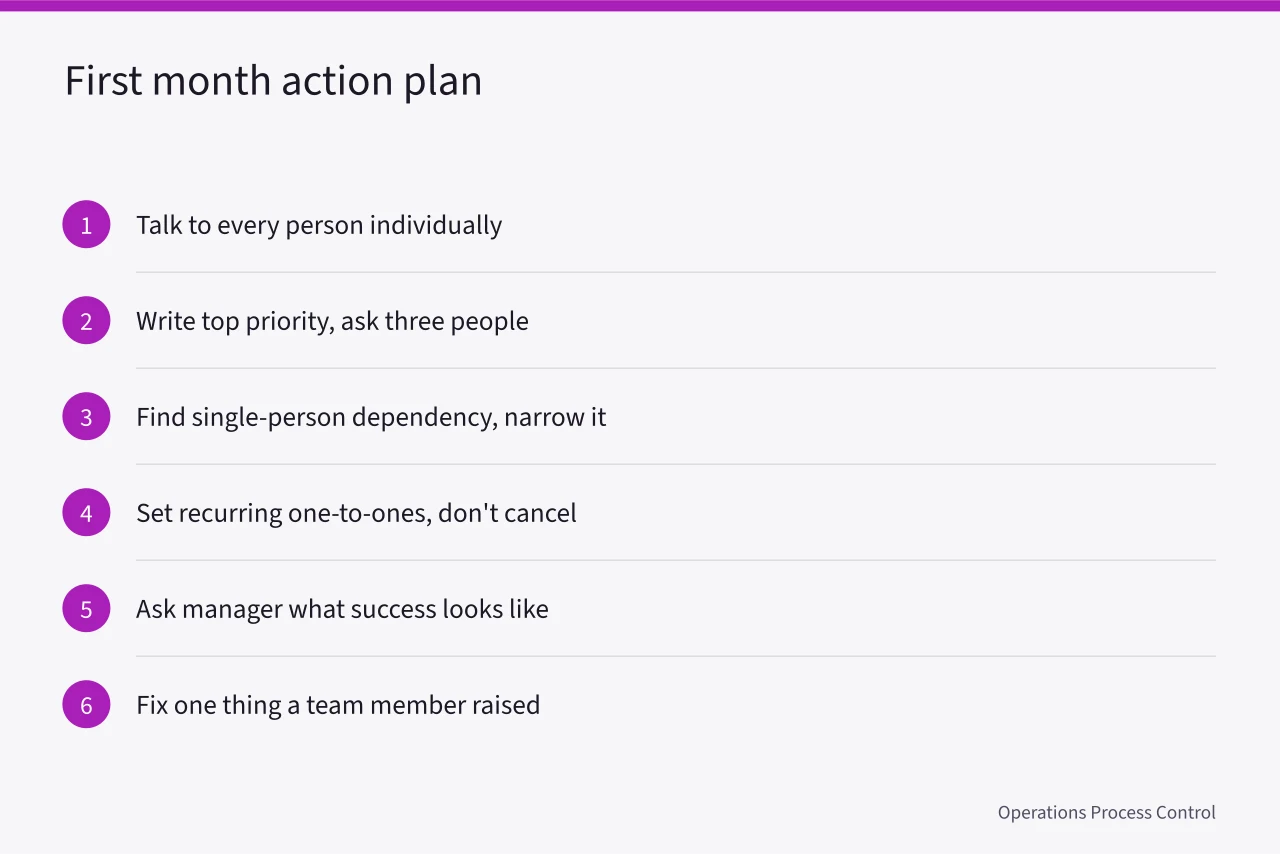
What to do in your first month
- Talk to every person individually, with the same questions, and write down the answers.
- Write down what you believe the top priority is. Ask three people what they think it is. Reconcile.
- Find the work only one person can do, and start narrowing that dependency.
- Set up a recurring one-to-one with each person and do not cancel one.
- Ask your own manager what success looks like in six months, specifically enough to check.
- Find one thing to fix that a team member raised, and fix it visibly.
For the day-to-day mechanics that follow (one-to-ones, delegation, meeting load, and handling conflict), see team management. For the wider set of practices this sits within, see the management foundations overview.
Common questions
Should I tell my team I do not know what I am doing?
Admitting you do not know a specific thing builds credibility. Announcing general uncertainty about your ability to do the job transfers your anxiety to people who cannot resolve it. Be honest about facts, contained about doubts.
How do I manage people who were my peers?
Address it once, directly, rather than hoping it settles. Acknowledge that it is awkward, say how you intend to work, and then be consistent: particularly with the people you were closest to, where any perception of favoritism will be noticed first.
How long before I am any good at this?
Longer than you would like, because the feedback loop is slow. A reasonable interim check is whether people bring you problems early. When they stop, something is wrong, and you will usually find out much later than you would want to.