Guides
Process Mapping vs Value Stream Mapping: Which One Fits a Service Business?
Process mapping vs value stream mapping: which fits a US service business? Compare criteria for healthcare revenue cycle, insurance claims, and software work.
What to take away
- Process mapping fits when you need to define who does what, in what order, and where handoffs fail.
- Value stream mapping fits when wait time, queue length, and flow time dominate the customer experience.
- Use both if the work crosses three or more teams and the backlog is measured in days.
- Neither method fixes demand variability or staffing capacity on its own.
- Start with the decision you must make, not the symbol set.
A process map and a value stream map answer different questions. The choice is about whether your problem is missing steps or lost time.
What is being compared
Process mapping documents steps, decisions, inputs, and owners. It can be a simple flowchart or a swimlane diagram. Value stream mapping documents the same flow but adds time: process time, wait time, and percent complete and accurate. The value stream mapping overview explains its origins and symbols.
In service work, a VSM usually includes information flow too, because a claim or a patient account moves through software as much as through people.
Process mapping is defined more broadly. The process mapping definition covers types such as high-level, detailed, and cross-functional maps. For teams that also need to track whether the process is improving, the team management metrics article explains how to pick a test before a dashboard.
The criteria that matter
Choose by the decision you need to support. If the problem is unclear ownership or missing steps, a process map is enough. If the problem is a queue that keeps growing, you need time data. The matrix below sets out the differences that matter to a service operation.
Process mapping
- Main question
- Who does what, in what order?
- Core data
- Steps, decisions, owners
- Typical output
- Flowchart or swimlane diagram
- Best fit
- New, undocumented, or disputed work
- Effort
- One to two days for a single-team map
- Main limit
- Can hide wait time
Value stream mapping
- Main question
- Where does time go?
- Core data
- Process time, wait time, percent complete and accurate
- Typical output
- Current-state and future-state map with time
- Best fit
- Queues, delays, and flow time
- Effort
- Two to six weeks for a cross-team flow
- Main limit
- Needs timestamps from at least one system
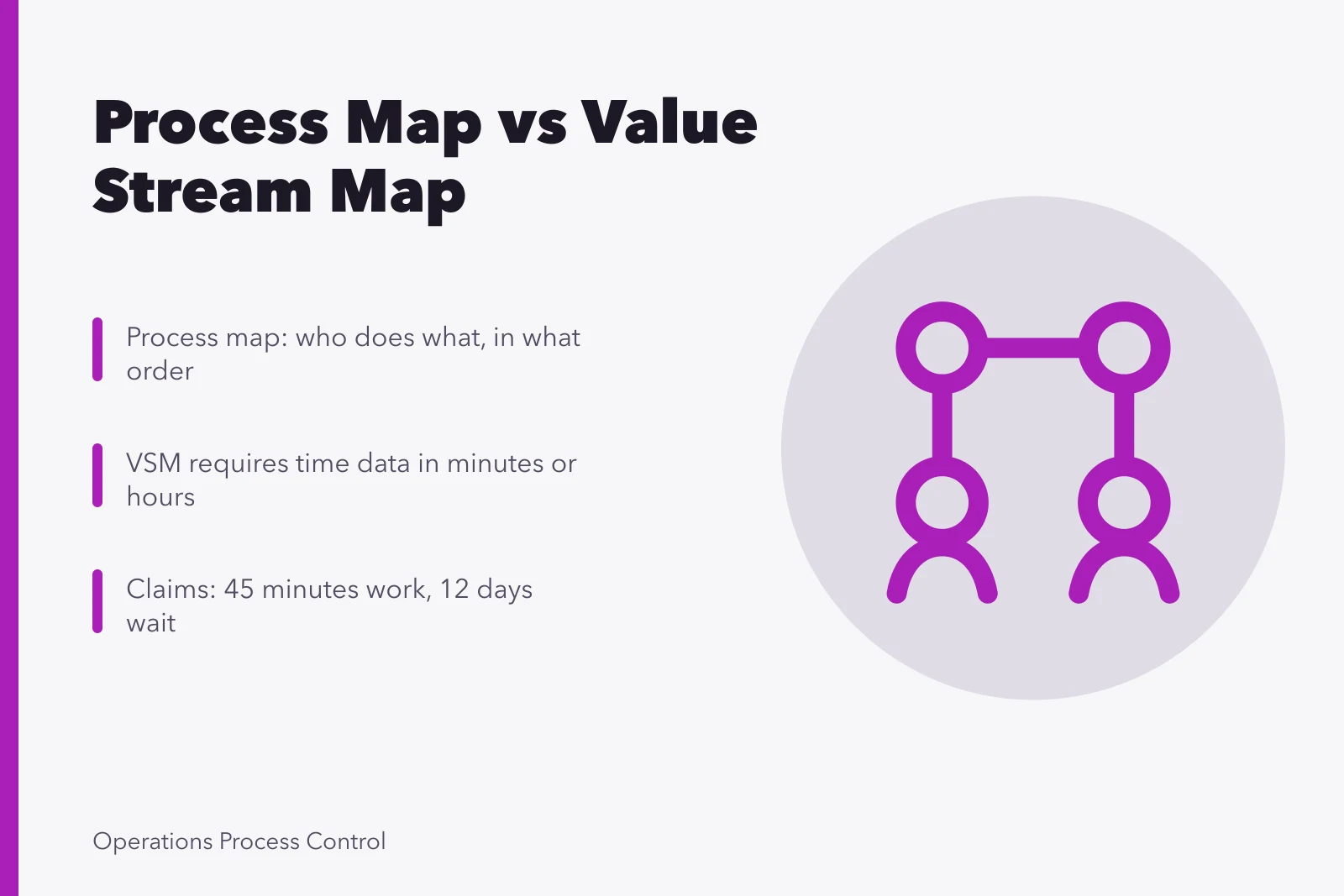
Process Map vs Value Stream Map
Process map
- Main question
- Who does what?
- Time data
- Optional
- Scope
- One process
- Output
- Steps, owners
- Data source
- Interviews, logs
- Typical effort
- Days to two weeks
Value stream map
- Main question
- How long does customer wait?
- Time data
- Required
- Scope
- End-to-end flow
- Output
- Flow time, wait time
- Data source
- Observation, timestamps
- Typical effort
- Two to six weeks
A simple onboarding process map can be finished in one to two days. A cross-team value stream map usually takes two to six weeks.
Option by option: process mapping
Use process mapping when the work is new, undocumented, or disputed. A software implementation team may map the path from signed contract to go-live. The map exposes missing approvals and duplicate data entry. The limitation is that a process map can look complete while hiding a seven-day wait.
If the flow crosses sales and delivery, the business development ops article covers the parts worth your attention. That handoff is often where the wait starts, before any service team touches the work.
Option by option: value stream mapping
Value stream mapping adds time and accuracy to the same flow. In an insurance claims process, a VSM might show that adjusters touch a claim for 45 minutes, but the claim sits for 12 days. That gap is the queue.
A typical cross-team claims VSM takes two to six weeks and can cut flow time by 20 to 40 percent, depending on how much wait sits between handoffs.
The map forces the team to count wait time, not just work time. It also shows rework loops, such as claims returned for missing documentation. The output is a future-state map with target flow time.
Example: healthcare revenue cycle
A hospital revenue cycle team mapped prior authorization for outpatient surgery. The process map showed 14 steps across scheduling, clinical review, and insurance verification. It did not show that the average case waited 3.2 days for a clinical reviewer. A follow-up value stream map added timestamps from the EHR and the payer portal.
The team found that 60 percent of the wait occurred between two handoffs. Neither map fixed the staffing shortage, but the VSM made the case for a dedicated reviewer during peak hours. After the reviewer was added, average flow time fell from 3.2 days to about 2 days.
The team also needed a change management plan to shift reviewer schedules.
Prior Authorization Wait Time
- 14steps in process map
- 3.2 daysaverage wait for clinical reviewer
- 60%wait between two handoffs
Where each one wins
Process mapping fits ownership, sequence, and training. Value stream mapping fits queue size and flow time. If both problems are live, map the process first, then add timestamps to the critical path.
What none of them solve
A map is a snapshot of one period. It will not produce a staffing model. Batch-recorded timestamps make a VSM unreliable. Queueing math still has to come from somewhere else.
A future-state map is not implementation. Schedules, software, and incentives still have to change.
Before you choose
Run this short checklist before you book a workshop.
- Name the decision the map must support.
- Check whether wait time is part of the problem.
- Confirm you can get timestamps from at least one system.
- Decide who owns the future-state changes.
For a wider view of how to set priorities, the pointers on management foundations article covers what holds up under pressure. That step keeps the map from becoming another document nobody uses.