Guides
Call center capacity planning under Texas and California wage rules
Texas and California wage rules change the paid hours that feed a call center capacity plan, so the same forecast needs different headcount in each state.
What to take away
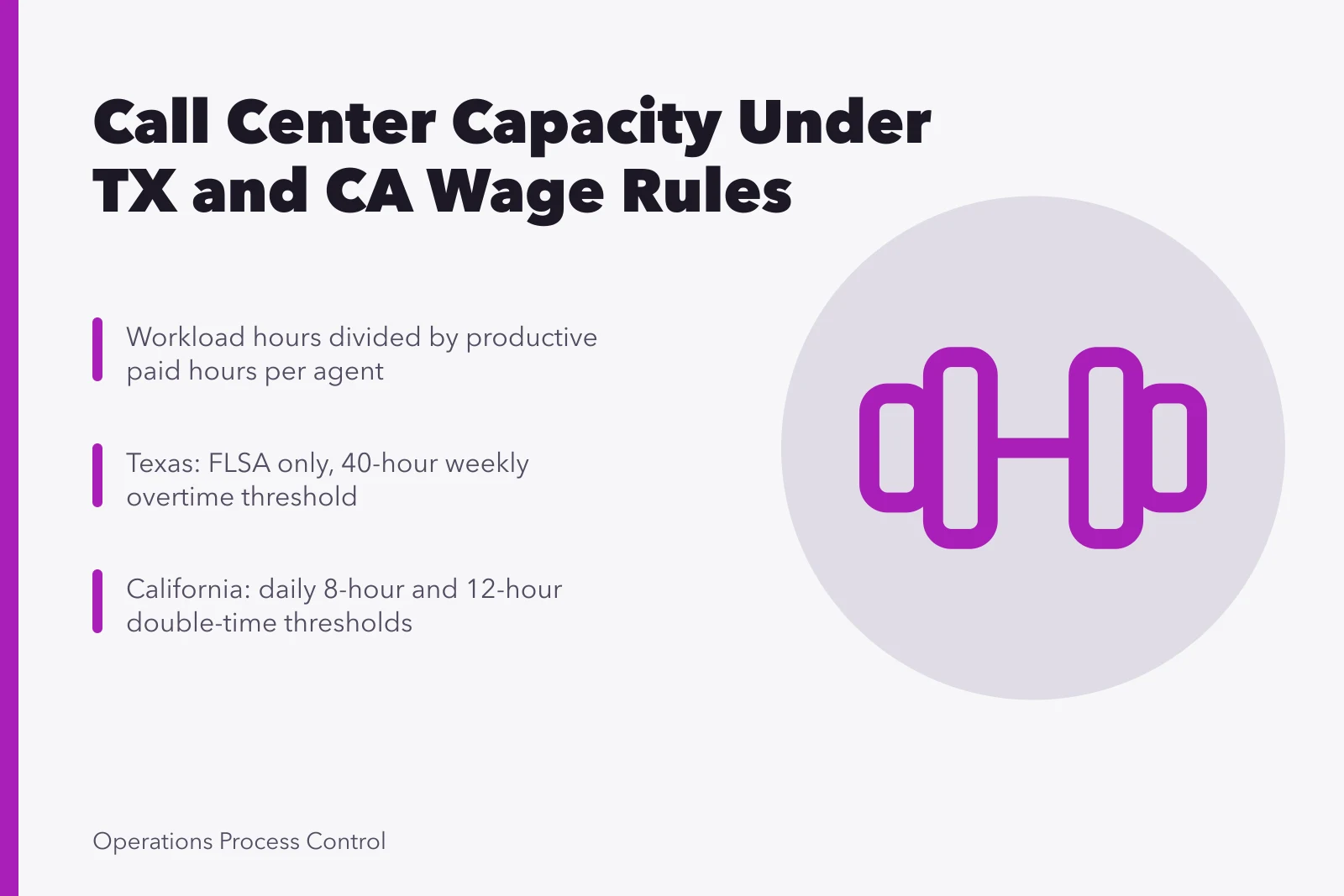
- The capacity planning formula is workload hours divided by productive paid hours per agent. Wage rules change the denominator, not the numerator.
- Texas has no state meal or rest break statute. The FLSA sets the floor: rest breaks of 20 minutes or less are paid, and a meal period of 30 minutes or more can be unpaid only if the agent is fully relieved of duty.
- California requires a 30-minute unpaid meal period before the end of the fifth hour, paid rest breaks of 10 minutes per four hours worked, and overtime after 8 hours in a day.
- A missed or late California meal period triggers one hour of premium pay at the regular rate. Unrecorded breaks turn into cost you never forecast.
- Treating agents as independent contractors removes them from the paid hours pool and creates back-pay exposure. California's ABC test makes that classification hard for call center work.
The formula, and the two wage inputs that move it
The capacity planning formula is a ratio. Workload hours sit on top: call volume times average handle time, plus after-call work. Productive paid hours per agent sit underneath: scheduled hours minus shrinkage, minus paid break time.
Most planners treat that as arithmetic. In Texas and California it is a wage calculation, because two inputs in the denominator are set by law rather than by the workforce management tool. Those inputs are paid break time and overtime premiums.
The federal Wages and the Fair Labor Standards Act | U.S. Department of Labor sets minimum wage, overtime after 40 hours in a workweek, and recordkeeping duties. Texas has no state break statute, so the FLSA is the whole floor there. California adds daily overtime and mandated breaks on top.
Wage data anchors the cost side. The Occupational Employment and Wage Statistics (OEWS) Tables : U.S. Bureau of Labor Statistics publish mean and percentile wages for customer service representatives by state and metro. Substitute your own metro figure into the model rather than a national average.
Employer duties are not optional inputs. The Resources for Employers | U.S. Department of Labor page collects the wage-hour obligations that apply once you schedule agents in two states. Those obligations decide which hours are paid.
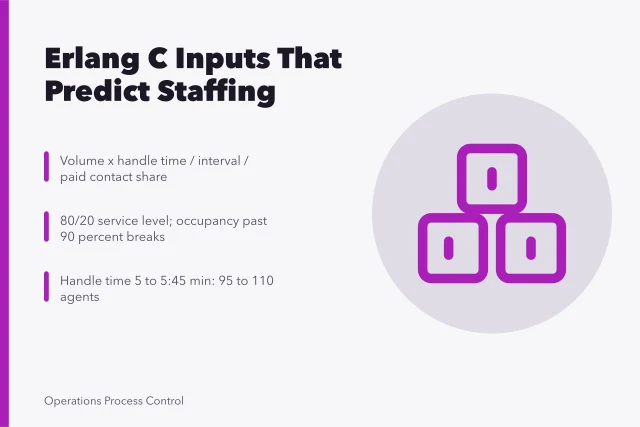
If you are rebuilding the model, start with the inputs that actually predict staffing rather than the output. Volume, handle time and paid hours per agent are the three that survive an audit.
Texas: breaks are policy, and policy is a planning choice
Texas has no state meal or rest break law. Whatever the employer writes into policy becomes the schedule, bounded by the FLSA. That is real flexibility, and it is also rope.
Under the FLSA, rest breaks of 20 minutes or less count as hours worked and must be paid. A meal period of 30 minutes or more can be unpaid when the employee is completely relieved from duty to eat a regular meal.
A Texas center can schedule an unpaid 30-minute meal plus two paid 10-minute rests. It can also schedule no breaks at all, provided every hour worked is paid. The first choice lowers paid hours per shift; the second raises them.
That choice feeds the formula directly. On an 8-hour shift with an unpaid meal and two paid rests, paid time is 7 hours 50 minutes. Make the meal paid and it becomes 8 hours 20 minutes. The spread is 30 minutes per agent per shift, every shift, all year.
Texas also follows the FLSA overtime rule only: time and a half after 40 hours in a workweek. There is no daily overtime. A planner can run a 10-hour Monday without triggering premium pay, as long as the weekly total stays at or under 40.
That is the freedom Texas offers. A Monday spike can be absorbed with four 10-hour shifts instead of five 8-hour shifts, which cuts the number of agents needed on the peak day.
California: the break clock sets the shift length
California meal, rest and overtime rules are stricter, and they decide what shift length is even schedulable. State wage orders require a 30-minute unpaid meal period before the end of the fifth hour of work, and a second one before the end of the 10th.
Rest breaks are paid. California requires 10 minutes of rest per four hours worked or major fraction of four. A shift over 6 hours and up to 10 gets two rest breaks; over 10 and up to 14 gets three.
Overtime is both daily and weekly. Time and a half is due after 8 hours in a day and after 40 in a workweek. Double time is due after 12 hours in a day, and after 8 hours on the seventh consecutive day.
The practical result: a California agent cannot work a 10-hour shift without a second meal period and three rest breaks. Paid time on that shift is 10 hours minus two unpaid meals, plus paid rest.
Compare the two states on the same 10-hour shift. Texas adds 10 paid hours to the pool. California adds roughly 9 hours 30 minutes after meals plus 30 minutes of paid rest, so about 10 hours, and the overtime premium is the larger cost.
California also requires meal and rest breaks to be recorded. A missed or late meal period triggers one hour of premium pay at the regular rate. A forecast that omits that premium will understate cost every single week.
The same pattern shows up across borders in Provincial Employment Standards for Shift Scheduling, where break and overtime rules vary by jurisdiction. Read the local rule before you set the shift.
Overtime thresholds reshape the staffing curve
The FLSA threshold is 40 hours in a workweek. Texas uses only that one. California uses the 40-hour threshold plus a daily 8-hour threshold and a 12-hour double-time threshold.
The daily threshold is what bends the curve. In Texas you can schedule a 10-hour Monday and a 6-hour Friday with no overtime, provided the week totals 40. In California, that 10-hour Monday owes 2 hours of premium even when the week totals 40.
So the constraint is shape, not just cost. Texas planners front-load hours into the peak day. California planners spread hours evenly to dodge daily overtime, which raises the agent count on the peak day.
A worked comparison makes it concrete. A Texas center covering a Monday spike can run 40 agents on 10-hour shifts. A California center covering the same spike on 10-hour shifts pays 2 premium hours per agent, or it runs 50 agents on 8-hour shifts.
The first option costs premium pay. The second costs headcount. Both are legitimate; the mistake is pricing only one of them.
Weekly overtime still applies in both states. A Texas agent at 42 hours owes 2 overtime hours. A California agent at 42 hours across five 8.4-hour days may already have crossed the daily threshold before the weekly total was reached.
Model both thresholds. Compute weekly overtime first, then apply the daily rule for California, and pay the higher of the two.
Shrinkage, occupancy and paid break time
Shrinkage is the share of scheduled time not available for calls. Occupancy is the share of available time actually spent on calls. Together they bridge the forecast and the formula.
Standard shrinkage covers paid breaks, unpaid breaks, training, coaching, absenteeism and system downtime. Texas shrinkage runs lower because paid rests are short and unpaid meals drop out. California shrinkage runs higher and less predictably, because breaks are paid, timed and recorded.
A Texas agent on an 8-hour shift might carry 30 minutes unpaid meal, 20 minutes paid rest, 30 minutes training and 20 minutes absenteeism: 100 minutes, about 21 percent shrinkage.
The same agent in California might carry the same items plus 15 minutes of meal premium or missed-break time: 115 minutes, about 24 percent. That extra three points is the compliance cost showing up as coverage.
Occupancy cuts the other way. At 85 percent occupancy, agents spend 85 percent of available time on calls and 15 percent on after-call work or waiting. Pushing occupancy higher lifts service level and lifts burnout and attrition, which feeds back into shrinkage.
Paid break time is the input planners miss most. Subtract it from scheduled hours before dividing workload by productive hours. Subtract it afterward and you count it twice, once in shrinkage and once in the denominator, and you understate headcount.
Use the operating processes metrics worth tracking to decide which shrinkage components get measured weekly. Break adherence and schedule adherence move the formula fastest.
A worked comparison of one forecast in both states
Take a forecast of 10,000 calls per day, average handle time of 6 minutes, and after-call work of 1 minute. Workload is 10,000 times 7 minutes, or 70,000 minutes. That is about 1,167 hours per day.
Texas vs California Staffing
Texas
- Paid hours per shift
- 7h 50m
- Shrinkage
- 21%
- Productive paid hours
- 6h 11m
- Agents needed
- 222
California
- Paid hours per shift
- 7h 50m
- Shrinkage
- 24%
- Productive paid hours
- 5h 57m
- Agents needed
- 231
Assume a 7-hour operating day and a service level target that requires 85 percent occupancy. Productive hours needed are 1,167 divided by 0.85, about 1,373 hours. Now apply each state's shrinkage and paid break time.
Worked comparison in both states
Texas
- Shift length
- 8 hours
- Unpaid meal
- 30 minutes
- Paid rest
- 20 minutes
- Paid hours per shift
- 7 hours 50 minutes
- Shrinkage
- 21%
- Productive paid hours per agent
- 6 hours 11 minutes
- Agents needed for 1,373 hours
- 222
California
- Shift length
- 8 hours
- Unpaid meal
- 30 minutes
- Paid rest
- 20 minutes
- Paid hours per shift
- 7 hours 50 minutes
- Shrinkage
- 24%
- Productive paid hours per agent
- 5 hours 57 minutes
- Agents needed for 1,373 hours
- 231
The same forecast needs 222 agents in Texas and 231 in California, nine more, about 4 percent. The gap widens once California agents work 10-hour shifts and trip the daily overtime rule.
Now add the Monday spike. Texas covers it with 10-hour shifts and no daily overtime. California cannot. Ten-hour shifts there cost 2 premium hours per agent; 8-hour shifts cost additional headcount instead.
That is the whole comparison. Texas buys flexibility with weekly overtime only. California buys compliance with daily overtime and mandated breaks, and pays in premium hours or in agents.
Test the assumptions before you finalize. Team management metrics start with a test, and a forecast built on untested handle-time data will miss in both states.
Where misclassification enters a bilingual staffing model
Misclassification enters when a center treats agents as independent contractors to avoid paid break time, overtime and payroll taxes. The FLSA economic realities test weighs control, profit opportunity, investment, skill and permanence.
A bilingual agent on a set schedule, using company equipment, taking calls from a company queue is an employee under the FLSA. The Misclassification of Employees as Independent Contractors Under the Fair Labor Standards Act | U.S. Department of Labor sets out the test and the back-pay exposure.
Misclassification also corrupts the model. Contractors are not in the paid hours pool, so a forecast that counts them as contractors understates both the paid hours required and the cost of compliance.
Enforcement differs by state. Texas applies the FLSA test. California applies a stricter ABC test, which makes contractor classification difficult for call center work. The same bilingual staffing model carries more risk in California than in Texas.
The fix is to classify correctly, then build paid hours into the forecast. Include meal and rest breaks, overtime premiums, and training time in the denominator. Document the schedule and break records.
For the rules that apply where you operate, check the Regulatory Library | U.S. Department of Labor. For California wage orders and Texas employment questions, confirm with the state labor office or counsel; this article states what the standards require, not what your operation must do.
Classification is also a performance question. Getting performance management right starts with a correct employment relationship, because you cannot coach a contractor the way you coach an employee.
Common questions
Does Texas require meal and rest breaks?
No. Texas has no state meal or rest break statute, so breaks are employer policy. Rest breaks of 20 minutes or less must still be paid under the FLSA, and any hour worked is a paid hour.
How do California breaks change the capacity planning formula?
They raise paid hours per shift and raise shrinkage. An 8-hour shift yields about 7 hours 50 minutes of paid time after meals and rest, and recorded breaks plus possible premium pay push shrinkage above the Texas figure.
When does overtime start in each state?
Both follow the FLSA 40-hour workweek threshold. California adds daily overtime after 8 hours and double time after 12 hours, which Texas does not have. Model both thresholds and pay the higher result.
Can bilingual agents be independent contractors?
It depends on the state and the facts. California's ABC test makes contractor classification hard for call center work, and the FLSA economic realities test governs in Texas. Misclassification creates back-pay liability, so confirm the classification with counsel before you build it into a forecast.