

Guides
How to Measure Communication Skills in Remote Teams Without Surveys
Communication skills metrics for remote teams: track response latency on decision threads, know when to act, and see what the number cannot tell you.
What to take away
- Response latency on decision threads is the async metric worth a weekly chart. It is the working-hours median from the first message to the first reply that moves the decision.
- Act when the weekly median passes 4 working hours for two weeks running.
- The number measures availability, not clarity. A fast reply can still leave the decision open.
- Two or three metrics per team beat a dashboard nobody opens.
A remote team can put a number on communication without asking anyone how they feel. Work from the exchange that matters, not from every message sent. The unit is the decision thread.
Name the metric before you collect anything
A decision thread is any thread whose first message asks for a choice: approve, reject, pick one, assign. Response latency is the working-hours median between that message and the first reply that advances the decision.
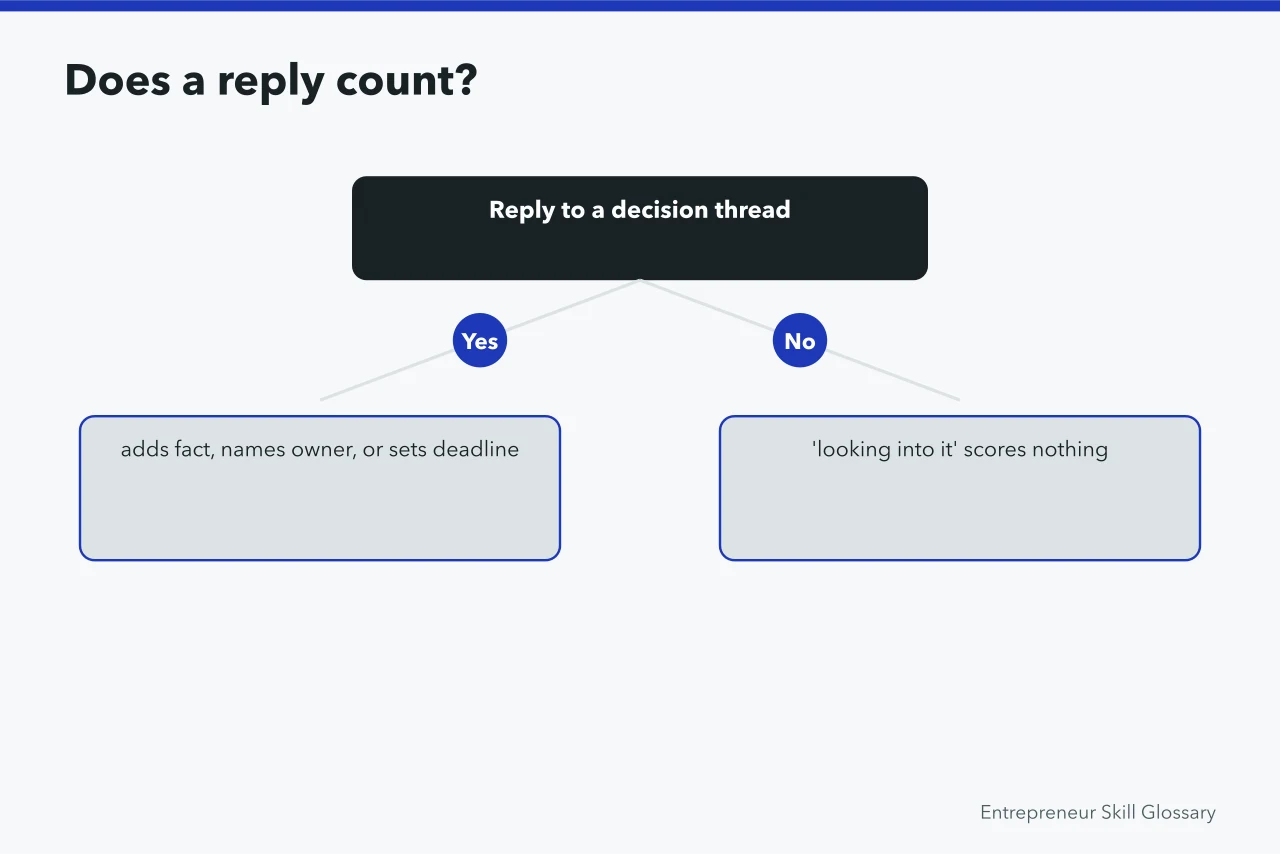
Advance needs a test anyone can apply. A reply counts only when it adds a fact, names an owner, or sets a deadline. 'Looking into it' scores nothing. That rule matters more than which tool supplies the timestamps, because a fast non-answer is how a team looks responsive while staying stuck.
Teams that skip the definition step end up comparing numbers that never measured the same event, a trap common to any business vocabulary metrics program. Write the definition down and keep it where the team can see it.
Count working hours, not clock hours, in each person's local zone. A thread that opens at 5 p.m. Eastern and closes at 9 a.m. Pacific shows a short gap, not a long one. Treat the figure as a performance indicator you can defend with the thread log behind it.
Zoom calls and recorded standups carry decisions too, but they are harder to score on the same clock. Leave them out for the first month and score text threads only.
How to read a week of data
| Metric | What it counts | Act when |
|---|---|---|
| Response latency | Working-hours median from first message to first advancing reply | Above 4 hours for two weeks |
| Closure rate | Share of decision threads with a written outcome inside 48 hours | Below 70% for two weeks |
| Owner naming | Share of decision threads that name one accountable person | Below 90% |
| Reopen rate | Share of closed threads reopened within seven days | Above 20% |
Those thresholds are illustrative starting points, not published benchmarks. Set your own after a four-week baseline, and read the median instead of the mean.
One thread that runs eight days will pull an average far from the typical case. The broader set of figures a business tracks appears in business acumen metrics worth tracking, which separates numbers that guide decisions from numbers that decorate reports.
A team can hold a 40-minute median and still miss every date, because the replies arrive quickly and settle nothing.
Example: scoring a single thread
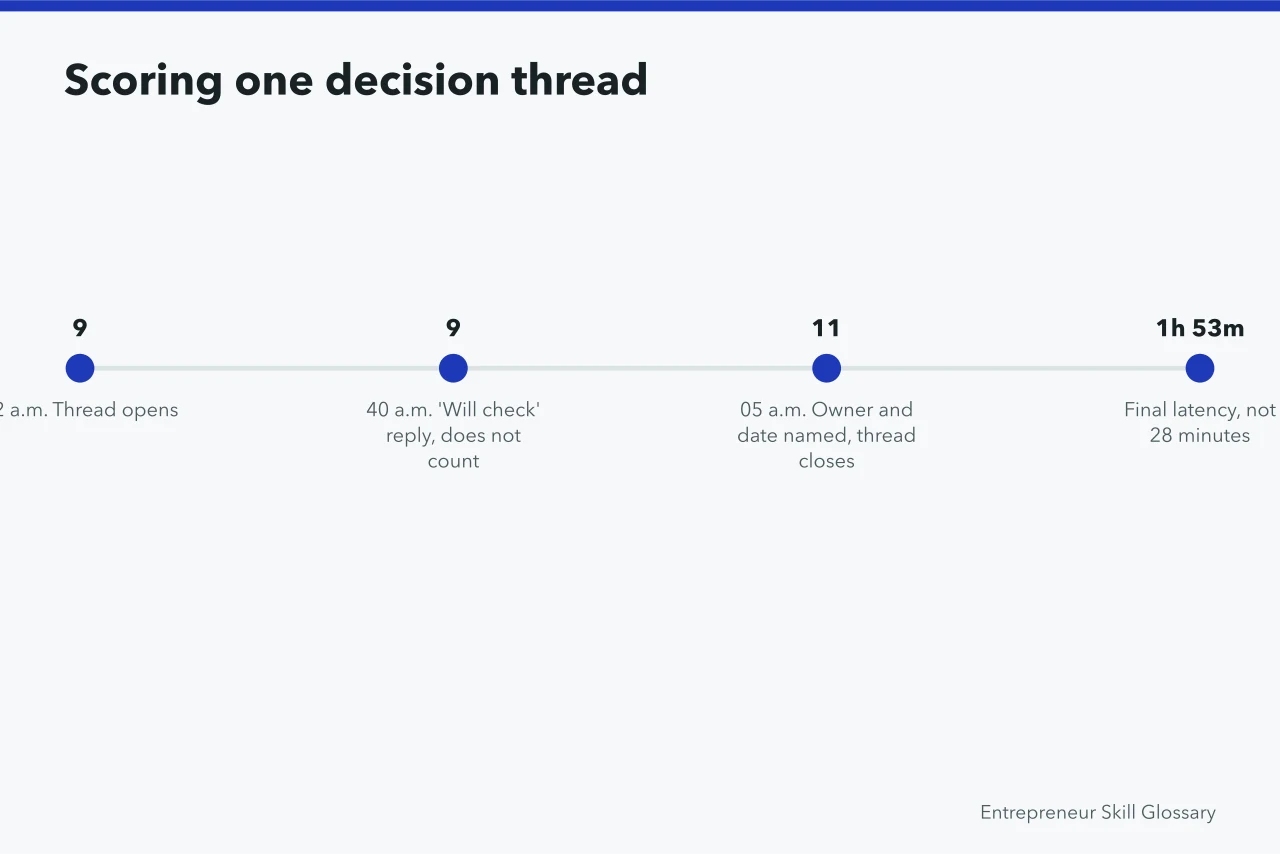
A thread opens Tuesday at 9:12 a.m. Eastern. A manager replies at 9:40 with 'will check and get back.' That reply does not count. At 11:05 an engineer names an owner and a review date, so the thread closes with a latency of 1 hour 53 minutes rather than 28.
Repeat across the week, then take the median. Five threads at 25 minutes, 1 hour, 3 hours, 6 hours and 2 days give a median of 3 hours.
What it cannot tell you
Latency measures availability and channel habits, not whether a question was clear. A vague request that gets a quick yes logs a good number and creates work later. Reopen rate is the only row above where that shows up, and it shows up late.
The metric also flatters teams whose hours overlap. A US team from Eastern to Pacific shares about five working hours a day, so a 4-hour median sits near what the schedule allows. Three people in one city beat that number without communicating any better.
A thread can also close on a phrase that hides the decision rather than recording it. Corporate jargon compared draws the line between a term of art and a phrase doing social work, which is the distinction to keep when you score an outcome. Latency records the reply, not the meaning.
Attribution and its limits
Latency moves for reasons unrelated to skill: a holiday week, an outage, a product launch. Read the thread log before blaming a person. One odd week is noise; two with the same shape is a pattern.
Remote work dynamics removed the hallway correction, so a stalled question now sits in a thread instead of getting fixed in a doorway. Federal guidance frames the response as a performance management cycle where a measurement period feeds a development plan. Measure, then plan, then measure again.
When to stop measuring and decide
Measurement is scaffolding, not furniture. Stop when three things are true.
- Six weeks with the median under the act level and no upward drift.
- A named owner for the next process change.
- A date to re-check, no more than a quarter out.
Then drop to a monthly read and stop reporting the number in meetings. Keep the raw thread log for one quarter so you can explain a bad month if one arrives. Stalled decisions usually trace back to how a team decides rather than how it types, and business acumen mistakes worth avoiding early covers the ones that repeat.